Why Strategies Fail
Common strategy dysfunctions and how to cure them

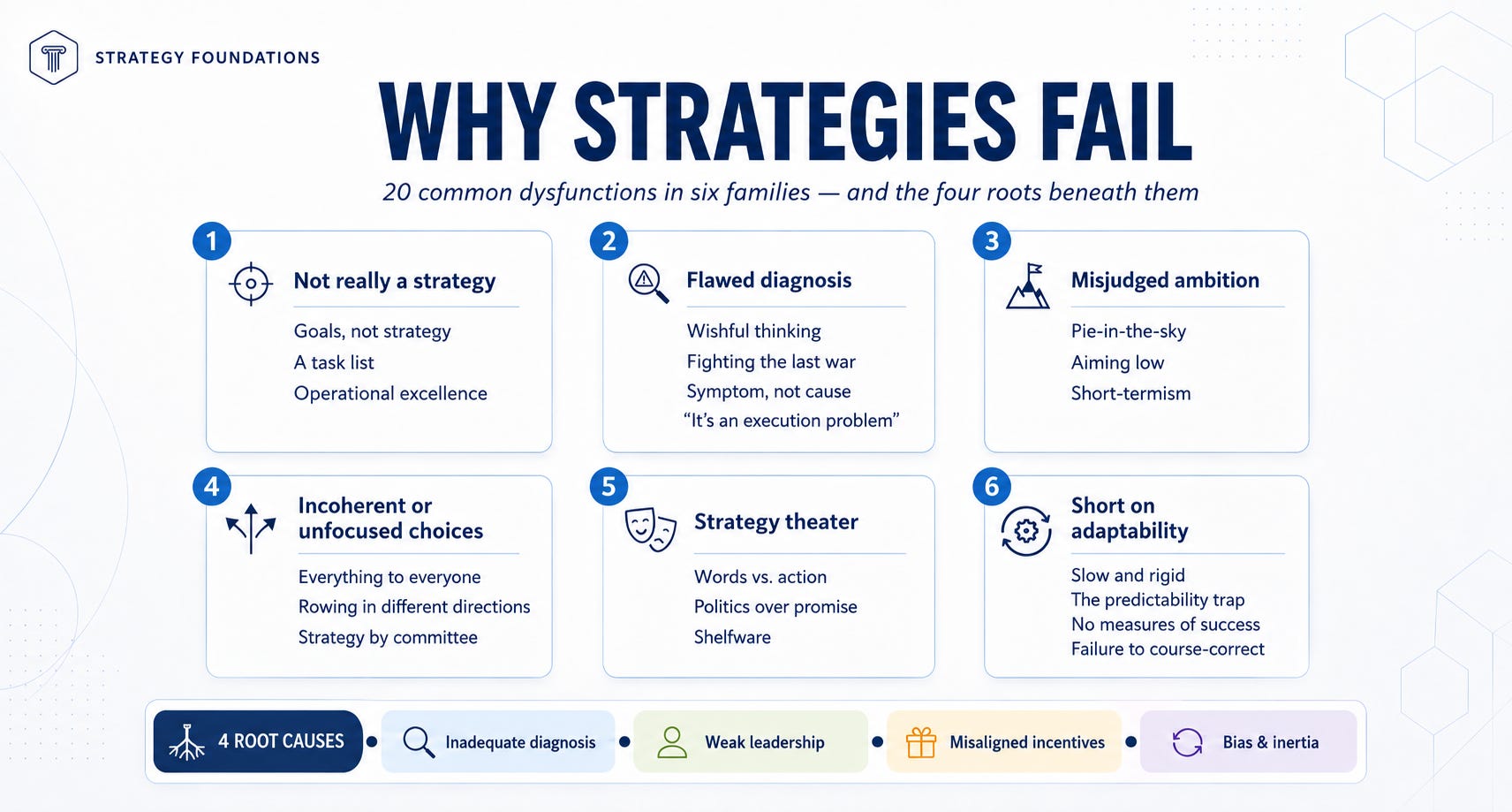
Almost every business has something they call a “strategy.” Come back in two years and you’ll often find it underperformed or didn’t work at all. Strategy fails far more often than it succeeds.
Yet strategies fail in distinctive ways. When you name the dysfunction, you can recognize it. And when you identify the mechanisms beneath the dysfunction, you can address them.
What follows is a guide to the twenty common strategy dysfunctions, organized into six families, mapped to the four roots that produce them. The families tell you where it’s going wrong. The roots tell you why; hence that’s where the leverage lies.
We’ll also show that each dysfunction is the mirror image of something a working strategy gets right. So, read in reverse, this becomes a description of effective strategy.
1. It’s not really a strategy
The most common failure is the most basic: the thing you’re calling a strategy is simply not one.
1. Goals, not strategy. Targets and aspirations with no coherent plan to reach them; a destination without a roadmap to get there.
2. A task list. A stack of activities that fail to address the real strategic challenge with coherence and leverage; motion mistaken for direction.
3. Operational excellence. Doing the same things better and calling it strategy. Valuable and necessary, but never sufficient: strategy requires choice and coherence (who to serve, what to offer, how to win, what to refuse), not just how well you do it.
What good looks like: a coherent set of choices aimed at a real, important, and addressable challenge. (For more on this see: What is Strategy?)
2. Flawed diagnosis
Strategy starts with a clear-eyed understanding of your situation. Get that wrong and everything downstream inherits the error.
4. Wishful thinking. Seeing the situation as you wish it were instead of as it is; failure to recognize the critical dimensions of your circumstance; this is the optimism bias at work.
5. Fighting the last war. Reading today through yesterday’s model; mental maps not updated despite a change in the territory.
6. Symptom, not cause. Treating surface problems instead of their underlying cause; missing the crux of the situation.
7. “It’s an execution problem.” Blaming the team for an execution shortfall that’s really a strategy problem.
What good looks like: an insightful diagnosis that names the most important addressable strategic challenge(s) — the crux of the situation — before reaching for answers.
3. Misjudged ambition
A strategy requires an aim. You can miss in three directions: too little realism, too little ambition, or too short a horizon.
8. Pie-in-the-sky. Ambition with no achievable path; a big vision that’s detached from reality.
9. Aiming low. Playing it safe; too conservative; me-too strategies that settle for parity.
10. Short-termism. Optimizing for the short-term while sacrificing long-term opportunities.
What good looks like: an aspirational vision grounded in realism; high ambition and high achievability pursued simultaneously over a meaningful horizon; bold about the vision, honest about the path.
4. Incoherent or unfocused choices
Strategy requires making choices that are coherent and focused. There are three ways this fails to happen.
11. Everything to everyone. Failure to prioritize: no real tradeoffs, lack of focus, resources spread across everything.
12. Rowing in different directions. Failure to align: teams pull toward conflicting priorities.
13. Strategy by committee. Failure to decide: consensus or compromise where the moment calls for a clear, narrowing choice.
What good looks like: coherent, focused choices; recognize real tradeoffs, establish clear selection criteria, and make clear decisions, including what you won’t do.
5. Strategy theater
Strategy as performing art. The motions of strategy substitute for substance.
14. Words vs. action. The strategy says one thing; the project approvals, resource assignments, and budget allocations say something else.
15. Politics over promise. Resources follow power, not merit or opportunity; the big divisions get the money and the mandate, irrespective of true potential.
16. Shelfware. A sales or investor story, not a decision guide or an actionable plan; presented, filed, and forgotten.
What good looks like: strategy and execution are fused; decisions are made in the interest of the organization, rather than individual leaders or teams; the strategy and budgeting processes are aligned.
6. Short on adaptability
A strategy that can’t keep up with the pace of change will soon become obsolete.
17. Slow and rigid. A planning cadence that moves slower than the environment; a fixed annual process when pivotal events happen quarterly or ad hoc.
18. The predictability trap. Leaning heavily on analysis and forecasts when the environment is too uncertain to predict; running a classical approach of “plan then execute” when an adaptive approach of “experiment and adjust” is needed.
19. No measures of success. No objective measures of success or progress, so no feedback loop, and no way to tell what’s working and what isn’t.
20. Failure to course-correct. Clinging to the plan as reality diverges; denial, inertia, and sunk cost fallacy at work.
What good looks like: strategy runs as a continuous loop; key assumptions are identified and validated; execution progress is monitored; course-corrections are proactive and timely.
The mechanisms behind the dysfunctions
You could read those dysfunctions and conclude the prescription is simple: just do the opposite. There’s truth in this. However, knowing what good looks like doesn’t necessarily tell you the best way to get there.
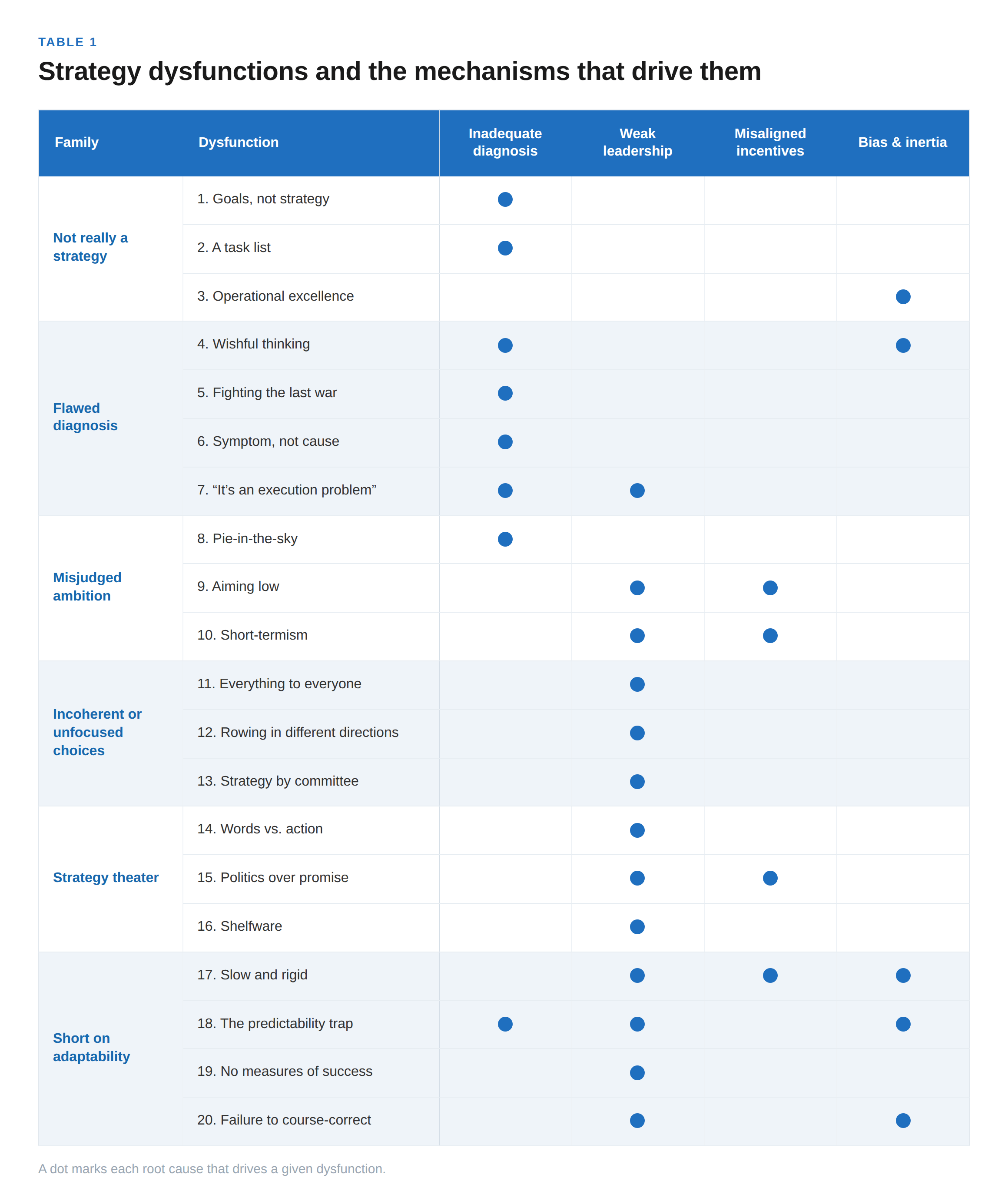
The families tell you where in the process the strategy breaks. They don’t name the mechanism underlying the dysfunction. Beneath the twenty dysfunctions sit four root causes. Each root drives multiple dysfunctions, so fixing a root clears many symptoms. That creates leverage.
Inadequate diagnosis. The situation was never adequately assessed or rigorously understood. This can be caused by blind spots or lack of information, by poor or shallow analysis, or simple denial where no one wanted to face the truth. The lever: Rigorous, insightful diagnosis; read your position and environment incisively, name the crux (the most important addressable challenge), and stress-test the plan’s key assumptions before you commit.
Weak strategic leadership. Many strategy dysfunctions stem from inadequate leadership. The hard calls are not made, conflicts are not resolved, or accountability is not enforced. The lever: Leadership that clarifies priorities, makes tough decisions even when they’re unpopular, aligns the organization, and sets an energetic pace. In short, ensuring that the strategy is defined and executed well.
Misaligned incentives. The people making decisions or driving results are rewarded for the wrong behavior or outcomes. For example, rewarding short-term performance when you want long-term results. The lever: Align rewards, compensation, and time horizons with the strategy’s larger goals; beware of unintended consequences and account for them.
Cognitive bias and inertia. Cognitive biases are pervasive in human nature and decision making, yet they’re commonly overlooked or denied. The most common ones pertaining to strategy include overconfidence, the planning fallacy, confirmation bias, escalation of commitment (sunk cost fallacy), and status-quo bias. The lever: Counter biases by design — use pre-mortems, decision checklists, the outside view, base rates, small reversible bets, pre-commitment contracts, and a standing date to re-examine assumptions.
Notice that the roots point in different directions. Some are failures of clear thinking (diagnosis, bias). Some are failures of will and ownership (leadership). Some are failures of structure (incentives). Matching a dysfunction to its root tells you whether you need a sharper analysis, a more courageous decision, or a different reward system.
The cure and the discipline are the same thing
Here’s the takeaway. Those four levers — insightful diagnosis, strong leadership, aligned incentives, minimizing bias and inertia — aren’t a separate repair kit you reach for when things go wrong. They are core disciplines of strategy done well. Curing the dysfunctions and practicing sound strategy are the same activity, seen from opposite sides. The dysfunctions manifest when the disciplines are missing.
These disciplines are foundational and prevent self-inflicted failure, yet they don’t guarantee success. First, some failures are exogenous: for example, market shocks, technology disruption, and regulatory change. Second, avoiding the dysfunctions makes strategy sound, not brilliant. It removes the flaws but doesn’t create an edge. Winning strategies emerge when the disciplines are in place and you add generative elements such as genuine insight, creative problem solving, and the development of unique resources and capabilities. We’ll cover those topics in future posts.
So, which of these dysfunctions are you experiencing? Most organizations have more than one, and they tend to cluster. Find the dysfunction that shows up most prominently, then look underneath it for the mechanism. That’s where the productive work lies.
If you want the positive version of all this, an approach for holistically addressing these dysfunctions, start with Strategy for Builders and Skeptics.